
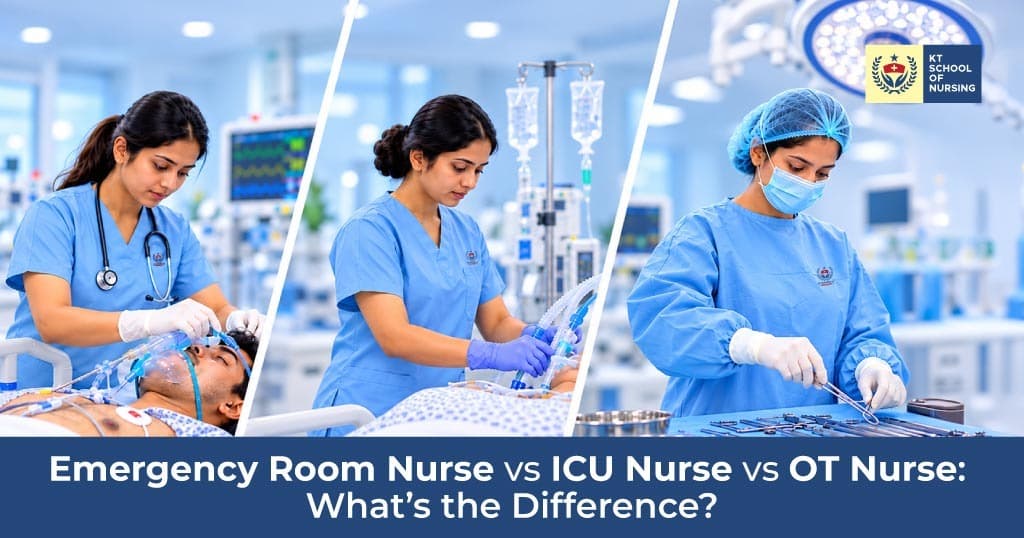
Nursing offers many career paths, but the differences between specialised roles are not always clear to students. An emergency room nurse, ICU nurse, and OT nurse all work in demanding hospital environments, yet their responsibilities, patient interactions, and day-to-day priorities can be quite different.
Understanding these differences can help students explore nursing as a career with a clearer idea of what different hospital settings involve. Students considering nursing education in Odisha can also use this understanding when comparing programmes and future career pathways offered by institutions such as KT School of Nursing, and consider which route aligns with their interests and goals.
Emergency room nurses work in emergency departments where patients may arrive with injuries, sudden illness, or other urgent healthcare needs. Because patients can have very different levels of urgency, emergency nursing involves prioritising care and responding as patients are assessed.
Triage is an important part of emergency nursing. The Emergency Nurses Association's overview of emergency department triage explains the role of triage in assessing patient acuity and prioritising care in emergency settings.
Depending on the healthcare setting, an emergency room nurse may help with initial assessment, monitoring, treatment procedures, communication with the healthcare team, and preparation for further care. The role can involve frequent changes in patient needs, making communication, organisation, and clinical judgement important.
Students interested in a hospital-focused pathway can explore the GNM Nursing Course in Bhubaneswar to understand how nursing education can build a foundation for clinical practice.
ICU nurses care for patients who require close observation and intensive nursing care. The AACN Scope and Standards for Critical Care Nursing Practice describes the practice of caring for critically ill or injured patients and outlines the responsibilities and professional standards of critical-care nurses.
The ICU environment usually requires continuous attention to patient condition, monitoring, documentation, communication, and coordination with other healthcare professionals. Nurses may also work with specialised equipment and support patients whose conditions require close clinical observation.
Students considering a B.Sc. Nursing Course in Bhubaneswar can review the programme structure and clinical-learning information offered by KT School of Nursing B.Sc. Nursing programme when exploring how undergraduate nursing education can support a future in hospital-based care.
An OT nurse, commonly described in professional literature as a perioperative nurse or operating-room nurse, works around surgical procedures. The role extends beyond the moment when surgery takes place.
The Association of PeriOperative Registered Nurses explains that perioperative nursing covers responsibilities in surgical and perioperative settings, with standards addressing professional practice and patient care. It identifies patient advocacy and safe perioperative care as important elements of the role.
Depending on the role and hospital, nurses in the operating theatre may work as scrub nurses or circulating nurses. Scrub nurses handle instruments and supplies used during an operation, while circulating nurses coordinate aspects of nursing care and help maintain a safe operating-room environment.
This means OT nursing can suit students interested in structured clinical environments, surgical procedures, teamwork, and careful attention to safety and sterile practice.
Although all three roles are part of professional nursing, the patient situation and work setting are different.
| Role | Main setting | Primary focus | Typical work characteristics |
|---|---|---|---|
| Emergency Room Nurse | Emergency department | Initial and urgent care | Rapid assessment, prioritisation and changing patient needs |
| ICU Nurse | Intensive care unit | Care of critically ill or injured patients | Close monitoring, complex care and continuous observation |
| OT Nurse | Operating theatre/perioperative area | Surgical and procedural care | Surgical preparation, intraoperative support and patient safety |
The key difference is not simply the job title. It is where the nurse works, what type of patient care is required, and at which stage of treatment the nurse is involved.
An emergency room nurse may be among the first nursing professionals involved when a patient arrives for urgent care. An ICU nurse focuses on patients who need intensive monitoring and care. An OT nurse works around surgical procedures and the wider perioperative process.
There is considerable overlap in the skills required across these areas, but the emphasis can differ.
Emergency nurses need strong communication, prioritisation and the ability to respond to rapidly changing situations. Triage also requires clinical knowledge and decision-making skills.
ICU nursing requires careful observation, clinical knowledge, teamwork and the ability to manage complex patient-care requirements. Critical-care standards emphasise professional practice, accountability and collaboration.
Perioperative nursing places strong emphasis on patient safety, coordination, surgical processes and attention to detail. AORN identifies patient advocacy and safe perioperative care as important elements of the role.
Students therefore do not need to decide on a specialised role before beginning their nursing education. A strong academic and clinical foundation can help them understand different areas of practice before choosing a direction.
For students exploring nursing after school, the choice of programme is one part of a longer career journey. The Indian Nursing Council's nursing programmes page outlines nursing programmes such as B.Sc. Nursing, GNM and ANM, along with training duration, examination and registration information.
KT School of Nursing currently lists B.Sc. Nursing, GNM Nursing and ANM Nursing among its programmes, giving students different educational pathways to consider based on their qualifications and career plans. When comparing nursing colleges in Bhubaneswar, students should look beyond the programme name and check factors such as curriculum, practical learning, clinical exposure, facilities, eligibility, and current admission requirements.
The right pathway also depends on the kind of nursing career a student eventually wants to pursue. A student interested in hospital-based critical care may want to learn more about intensive-care nursing, while another may be more interested in emergency care or the operating theatre.
Emergency room, ICU, and OT nurses all play important roles in patient care, but their working environments and responsibilities are distinct. Emergency nursing centres on urgent assessment and prioritisation, ICU nursing focuses on critically ill patients requiring close monitoring, and OT nursing supports patients through surgical and perioperative care.
Understanding these differences can help students develop a clearer picture of clinical environments. A B.Sc. Nursing Course in Bhubaneswar can provide a broad undergraduate foundation, while other nursing programmes may suit different pathways and goals.
Students who want to compare nursing programmes, eligibility, and admission information can contact KT School of Nursing through its enquiry page to discuss the available options.
An emergency room nurse works primarily with patients requiring urgent assessment and care in an emergency department. An ICU nurse focuses on patients who are critically ill or injured and need intensive monitoring and nursing care.
ICU nursing requires careful observation, clinical knowledge, teamwork, communication, and the ability to manage complex patient-care requirements. Nurses also need to monitor patients closely and coordinate with other healthcare professionals.
An OT or perioperative nurse supports patients around surgical procedures. Depending on the role, this can include preparing for surgery, assisting with intraoperative care, maintaining a safe environment, and supporting the wider perioperative process.
Communication, prioritisation, clinical knowledge, teamwork, and decision-making are important skills in emergency nursing, particularly where patients need to be assessed and prioritised quickly.
Students should consider curriculum, practical learning, clinical exposure, facilities, eligibility requirements, and current admission criteria. They can also consider how well the programme prepares them for their preferred nursing environment.



Turn your passion for care into a respected profession that changes lives every single day.