
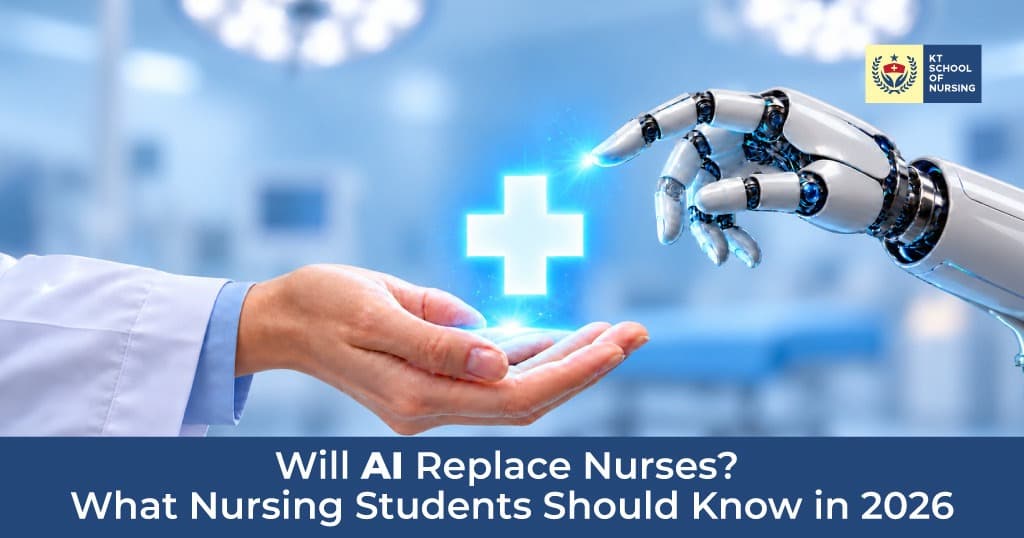
For students planning a nursing career, the rapid growth of artificial intelligence can raise a difficult question: will AI replace nurses? Headlines about automation can make the future of healthcare seem uncertain, especially when choosing a course or nursing college in Bhubaneswar.
AI is already being explored across healthcare for tasks such as summarising information, supporting clinical workflows, and medical and nursing education. At the same time, health organisations warn that AI can produce inaccurate or biased outputs and should not replace appropriate human oversight.
This article explains what AI can change in nursing, what remains dependent on nurses, and what students can do to prepare.
AI is more likely to change how nurses work than replace the full range of responsibilities that nursing involves. WHO guidance identifies healthcare uses for AI that include clinical care, patient-facing information, clerical and administrative work, and medical and nursing education. These uses can support parts of a nurse's workflow, but they do not turn nursing into a fully automated activity.
Nursing involves more than processing information. Nurses observe patients, communicate with patients and families, respond to changing conditions, coordinate care, and work as part of a healthcare team.
AI can also make mistakes. WHO highlights risks including false or incomplete outputs, bias, privacy concerns, and automation bias, making human review especially important.
The most useful way to think about AI in nursing is as a support technology. Its role may vary by workplace, system, and level of clinical oversight.
AI may help organise or summarise information, support documentation and administrative workflows, assist with educational simulations, identify patterns in large datasets, and support selected decision-making processes.
These uses do not mean that a nurse simply follows an AI system. Healthcare professionals still need to assess whether information is appropriate for the patient and situation. As AI governance is increasingly important in healthcare, WHO's guidance on AI for health highlights the need to consider safety, equity, and human oversight when AI systems are used.
The parts of nursing that depend heavily on human interaction and professional responsibility remain important. A patient may not only need information; they may be anxious, confused, in pain, or unable to explain what they are experiencing clearly.
Nurses need to listen, communicate, notice changes, respond to patient needs, and work with other professionals. They also need to recognise when a situation requires escalation rather than relying on an automated recommendation.
For students, this means technology skills should complement—not replace—clinical knowledge, communication and patient-care skills.
Future-ready nursing education is not about turning every nursing student into a technology specialist. It is about helping students use digital tools responsibly while maintaining strong clinical foundations.
Important areas include clinical assessment and reasoning, communication and patient interaction, digital and information literacy, teamwork, and ethical use of technology. The Indian Nursing Council provides information on nursing programmes, training duration, and registration requirements, which students can use alongside institution-specific details when comparing nursing courses.
Students exploring a B.Sc. Nursing pathway can review the B.Sc. Nursing programme details at KT School of Nursing to understand the programme structure and eligibility. The broader question is what kind of education will prepare a student for real patient care as healthcare technology evolves.
Choosing a nursing college is still fundamentally about the quality and relevance of the education. AI adds another consideration: whether students have opportunities to become comfortable with modern healthcare technology without losing the human side of nursing.
When comparing Nursing Colleges in Bhubaneswar, consider the programme offered, clinical exposure, practical training, faculty support, learning facilities, and the institution's regulatory or affiliation information.
Students and parents can use official regulatory information as one part of the college-checking process, alongside the institution's published programme, approval, and affiliation details. For families reviewing the top nursing colleges in Odisha or best nursing colleges in Odisha, the same principle applies: check programme details and regulatory information rather than relying on a ranking-style label.
KT School of Nursing currently lists ANM, GNM, and B.Sc. Nursing programmes, allowing students to compare different nursing pathways. Students should also verify the institutional approval and affiliation details published by KT School of Nursing before making a decision.
AI may also create new types of work around digital health, clinical information systems, data-informed care, and technology-supported education. The exact roles will depend on how healthcare organisations adopt technology and how professional and regulatory requirements develop.
The important point is not to predict one fixed future job title. It is to build a foundation that remains useful across healthcare settings. Strong clinical knowledge, communication, critical thinking, and the ability to learn new tools can help students adapt.
Students do not need to choose between nursing and technology. They can prepare for both. Start with a sound nursing foundation, then learn to evaluate digital information and understand what healthcare technologies can and cannot do. Question outputs rather than accepting them automatically, protect patient confidentiality, and keep human judgment at the centre of care.
This is especially relevant when comparing the best nursing colleges in Bhubaneswar. Look for an educational environment that treats practical nursing competence as essential while helping students engage with the changing healthcare landscape.
AI is likely to become a bigger part of healthcare, but the evidence supports a more nuanced view than “AI will replace nurses.” AI can assist with specific tasks, while nursing still depends on clinical knowledge, communication, observation, teamwork, and judgment.
For students and parents, the practical takeaway is to prepare for a nursing profession in which technology may be a tool used alongside human care. When comparing the best nursing colleges in Bhubaneswar, focus on the foundations that will remain valuable even as tools change: sound education, practical training, clinical exposure, and preparation for professional nursing practice. Students can explore the available nursing programmes and their requirements at KT School of Nursing before deciding which pathway fits their goals.
Current healthcare guidance points to AI supporting specific healthcare tasks rather than replacing the full range of nursing responsibilities. How the balance develops will depend on technology, clinical practice, regulation and human oversight.
Potential uses include documentation support, information summarisation, clinical decision support and nursing education. The exact use depends on the healthcare setting and the safeguards around the technology.
Students should build strong clinical knowledge alongside communication, clinical reasoning, digital literacy, teamwork, and the ability to evaluate technology-generated information.
Look at the programme, eligibility, practical and clinical training, learning facilities, faculty support, and official recognition or affiliation information relevant to the course.
Students should check official recognition and affiliation information from the relevant regulatory and academic authorities and compare it with the institution's published details. They should also verify that the specific programme they are considering meets the applicable recognition requirements.
Yes. AI can change parts of healthcare work, but students still need nursing education that develops clinical competence, patient-care skills and professional judgment. Technology should be considered alongside the fundamentals of nursing rather than as a replacement for them.

Turn your passion for care into a respected profession that changes lives every single day.