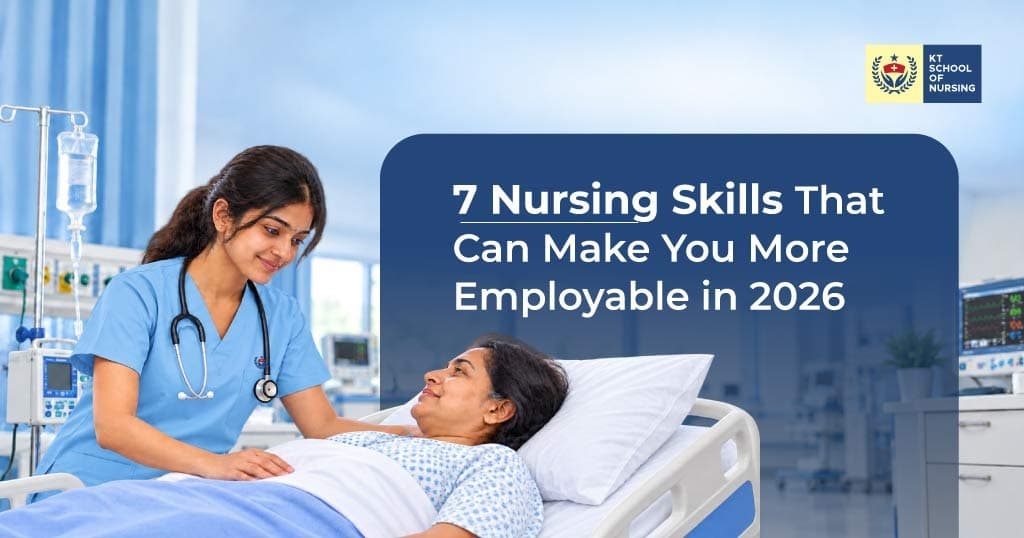
A nursing qualification provides the foundation for patient care, but employability also depends on how well students apply knowledge in practice. This guide covers seven nursing skills to develop in 2026: clinical competence, patient assessment, communication, critical thinking, teamwork, leadership and digital practice. It also explains how students can build evidence of these skills during training and use that experience when preparing for future roles.
Nursing students naturally focus on examinations, assignments and clinical assessments. Yet entering the workforce also requires clear communication, teamwork, the ability to think through changing situations, and the safe application of knowledge. Professional nursing standards treat these as connected capabilities. They include the knowledge, skills and attributes expected in professional practice.
This broader view helps students because it links practical ability with professional behaviour. The aim, therefore, is not to collect a long checklist of skills, but to develop technical ability, clinical thinking and professional behaviour that can be demonstrated through supervised practice, clinical postings, projects and interviews. Students researching the Best Nursing Colleges in Bhubaneswar can also explore the B.Sc. Nursing programme at KT School of Nursing as one example of the programme information worth reviewing.
Employability is not simply about holding a nursing qualification. Students also need to show what they can do, how they respond to patients and colleagues, and how they apply knowledge when circumstances change.
Technical abilities such as assessment, documentation and safe clinical practice demonstrate practical readiness. Communication, teamwork, problem-solving and organisation show how a student can function within a care team. Building evidence while studying is especially useful: a student who can explain a supervised experience or a problem they helped address has something concrete to discuss in an application or interview.
Clinical and technical nursing skills form the base of safe patient care. Depending on the programme and level of training, students may practise vital-sign measurement, basic assessment, hygiene, documentation, infection-prevention procedures and other supervised clinical tasks.
Do not focus only on memorising steps. Understand why a procedure is performed, what observations matter, when to seek supervision, and how to record information accurately. That turns a procedure into a professional skill rather than a checklist.
Nurses gather information, notice changes, and decide what needs attention. Strong observation and clinical judgement help students connect measurements, patient history, and other findings instead of viewing each detail separately.
Students can strengthen this skill through structured assessment, case discussions, and practising how to present findings. Learning to explain why one issue needs attention before another also develops the reasoning that supports safe decision-making.
Communication is central to nursing because care depends on accurate information sharing with patients, families, and healthcare professionals. The Nursing and Midwifery Council's communication standards include active listening, checking understanding, clear documentation, and sharing information during handovers and teamwork, as outlined in its standards of proficiency for registered nurses.
Good communication means more than speaking confidently. It includes listening carefully, using understandable language, checking whether information has been understood, and recording relevant details accurately.
Clinical situations do not always follow a predictable pattern. Students may need to recognise a change, identify relevant information, seek guidance, and decide what should be escalated.
Critical thinking develops when students ask why an action is appropriate instead of treating every task as routine. Case discussions, reflection after clinical activities, and comparing possible responses can strengthen this ability.
Nursing rarely happens in isolation. Students work with nurses, doctors, therapists, support staff, patients and families, making respectful collaboration an important part of practice.
Useful behaviours include listening to colleagues, sharing relevant information, accepting feedback and understanding one's role within the wider team. Clinical postings can provide valuable opportunities to observe how professionals coordinate care and reflect on what made the teamwork effective. The American Nurses Association also discusses communication and collaboration as important elements of nursing teamwork in its Teamwork in Nursing guidance, which can provide students with a useful professional reference.
Leadership in nursing is not limited to a formal management role. At student level, it can mean taking responsibility for assigned work, preparing properly, communicating concerns and contributing constructively to a team.
Time management supports this skill. Students can practise prioritising tasks, keeping accurate notes, preparing for clinical duties and meeting agreed timelines. These habits also create real examples of responsibility and initiative for future interviews.
The World Health Organization also highlights leadership, communication and collaborative teamwork within its nurse educator core competencies, providing a useful perspective on how these capabilities can be developed through education and training.
Nursing practice increasingly involves digital records, information systems and current evidence. Students can therefore benefit from being comfortable with digital documentation, finding reliable health information and distinguishing authoritative sources from unsupported online content.
Evidence-based practice also requires a willingness to update knowledge as guidance changes. Being able to explain where information came from, why a source is credible, and how evidence informs practice is a useful professional habit.
A nursing programme should help students move from classroom knowledge to supervised application. Practical laboratories, simulation, clinical postings, case discussions, community activities, and educator feedback can all contribute to skill development.
For students comparing nursing colleges in Bhubaneswar, the more useful question is whether the learning environment provides meaningful opportunities for clinical learning, practical skills development, and professional growth. Students exploring the published programme and clinical-learning information can use such details as one example of what is worth comparing.
KT School of Nursing publishes information on its B.Sc. Nursing, GNM and ANM programmes, with programme pages describing practical and clinical learning opportunities. Students can review the institution's programme information when comparing the type of training different programmes provide.
Students comparing nursing colleges in Bhubaneswar or looking for the best nursing colleges in Odisha may consider factors such as course structure, practical exposure, faculty support and clinical learning. When researching top nursing colleges in Odisha, it is also useful to look at published admission requirements, programme details, facilities and clinical-training information rather than relying only on general descriptions. This helps families compare what a programme offers with what the student actually needs.
The seven skills covered here, namely clinical and technical ability, patient assessment, communication, critical thinking, teamwork, leadership, and digital/evidence-based practice, work best together. The goal is to build competence, demonstrate it consistently, and explain that experience clearly.
For students and parents comparing nursing colleges in Bhubaneswar, the learning environment matters because skills develop through practice, guidance, and feedback. As you explore nursing education options, you can learn more about the programmes available at KT School of Nursing and reach out to the school for further information.
Nursing requires a combination of clinical and technical skills, patient assessment, communication, critical thinking, teamwork, professional responsibility and ongoing learning. The exact mix varies by role, setting and level of practice.
Students build foundational skills through their programme and supervised practice. These can include patient observation, vital-sign measurement, communication, documentation, hygiene and safe patient-care practices.
Technical skills are practical abilities used in nursing care, such as relevant clinical procedures, taking and recording observations, maintaining safe practice, and using clinical equipment appropriately within training and scope.
Communication, active listening, teamwork, interpersonal skills, organisation, adaptability, and professional behaviour are important because nurses work with patients, families, and multidisciplinary healthcare teams.
Include skills you can genuinely support with education, supervised practice, or experience. Choose relevant strengths and be ready to explain where and how you developed them.


Turn your passion for care into a respected profession that changes lives every single day.