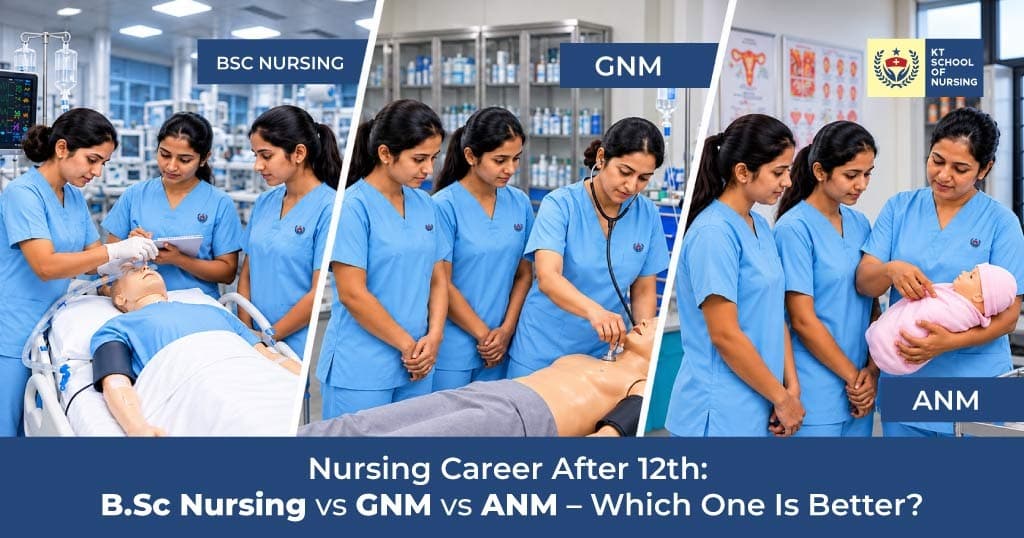
Choosing a nursing course after Class 12 is not only about duration. B.Sc Nursing, GNM, and ANM differ in eligibility, academic depth, training, and possible career progression. This guide helps students and parents compare the three pathways while considering nursing colleges in Bhubaneswar.
For students completing Class 12, nursing offers several academic pathways. The challenge is understanding which course matches their qualifications, preferred type of work, and longer-term plans. B.Sc Nursing, GNM, and ANM all lead toward nursing careers, but they are not interchangeable programmes.
The choice becomes especially important when comparing courses and institutions in Bhubaneswar. The B.Sc Nursing Course in Bhubaneswar is a degree-level pathway, while GNM and ANM have different durations, entry requirements, and areas of preparation. KT School of Nursing offers all three programmes for students interested in the field.
This guide compares the three options and highlights the practical factors students should consider before applying.
The Indian Nursing Council lists B.Sc. (Basic) Nursing as a four-year programme, GNM as a three-year programme under its revised duration, and ANM as a two-year programme. Students can review the Council's programme information and listings when comparing these pathways.
Duration, however, is only one part of the decision. Students should also compare eligibility, academic study, clinical learning, intended work settings, and future education plans. For B.Sc Nursing, the Indian Nursing Council's stated criteria include 10+2 with Physics, Chemistry, and Biology, English, and 45% aggregate marks. The minimum admission age is 17.
GNM requires 10+2 with English and 40% under the INC criteria. ANM has different eligibility routes. KT School of Nursing accepts students from Science, Arts, Commerce, and Vocational streams, subject to the applicable admission requirements. Since requirements may also depend on the state and institution, students should verify the rules for the academic year in which they plan to enroll.
| Factor | B.Sc Nursing | GNM | ANM |
|---|---|---|---|
| Level | Undergraduate degree | Diploma | Nursing programme |
| Duration | 4 years | 3 years | 2 years |
| Broad focus | Professional nursing education | Nursing and midwifery | Community, maternal and child healthcare |
| Suitable for | Students seeking a degree pathway | Students considering a diploma route | Students seeking a shorter entry-level pathway |
| Future study | Can support further nursing study | Further study depends on eligibility and progression route | Can be followed by further qualification where eligible |
These categories are broad; curriculum, clinical training and admissions should always be checked with the institution and relevant authorities. The Indian Nursing Council also publishes curriculum resources for nursing programmes.
The more useful question is therefore not which course is universally “better”, but which one fits the student's present qualification and career direction.
For students with the required science background who want a degree-level nursing education, B.Sc Nursing offers a four-year undergraduate route. KT School of Nursing lists its B.Sc. Nursing Course in Bhubaneswar as a four-year full-time programme with PCB and English requirements.
A degree can also be relevant to students considering further academic study. The Indian Nursing Council's eligibility information for M.Sc Nursing includes B.Sc Nursing and related recognised nursing degrees among the qualifications considered for entry.
When comparing colleges, look beyond the course name. Check recognition and affiliation, clinical learning arrangements, laboratories, student support, curriculum, and the admission requirements applicable to the current session. The Indian Nursing Council's eligibility criteria provide an important reference point, while institution-specific requirements should also be confirmed before applying.
GNM, or General Nursing and Midwifery, is a three-year programme in the Indian Nursing Council's programme-duration listing. It provides a diploma route into nursing and midwifery.
KT School of Nursing lists a GNM Nursing Course in Bhubaneswar focused on clinical nursing skills, patient care, and midwifery. Students should confirm the current admission criteria before applying because requirements can change. GNM may suit students who want a diploma pathway and are focused on nursing and midwifery practice, while also considering what additional qualification they may pursue later.
ANM, or Auxiliary Nurse Midwifery, is the shortest of the three programmes, with a two-year duration listed by the Indian Nursing Council. It is associated with areas such as community healthcare, maternal and child health, and primary care.
The ANM Nursing Course in Bhubaneswar at KT School of Nursing is described as a two-year full-time programme with a community and frontline healthcare focus. The shorter duration can be important for students who want an earlier entry-level pathway, but it should be weighed against the responsibilities they want and their plans for further education.
A practical comparison can start with five questions:
| Question | What to consider |
|---|---|
| What did you study in Class 12? | Check the programme's current subject and marks requirements. |
| How much time can you commit? | Compare the two-, three-, and four-year durations. |
| What qualification do you want? | Decide whether a degree or diploma route matches your plans. |
| What kind of nursing work interests you? | Consider hospital, community, maternal-care, clinical, or other settings. |
| Do you want further study later? | Check the progression options associated with your chosen qualification. |
Parents and students should also verify recognition and affiliation before enrolling. When comparing Nursing Colleges in Bhubaneswar, also evaluate facilities, clinical exposure, teaching support, and the transparency of the admission process rather than relying only on course names or advertisements.
There is no single nursing programme that is better for every student. B.Sc Nursing, GNM and ANM represent different educational pathways, and the most suitable choice depends on eligibility, qualification level, time commitment and career goals.
For students comparing these pathways, the decision should include the programme, institution, clinical learning opportunities and current admission requirements. Reviewing official eligibility rules alongside college-specific information can make the choice more informed.
KT School of Nursing provides information on its B.Sc Nursing, GNM and ANM programmes, allowing students and parents to compare the course-specific details before taking the next step. For more information about the programmes or admission process, contact KT School of Nursing to discuss the options available.
Neither is universally better. B.Sc Nursing is a four-year undergraduate degree, while GNM is a three-year nursing and midwifery programme. The right choice depends on the student's eligibility and long-term plans.
ANM is a two-year programme, while GNM is a three-year programme. They also differ in training and qualification level. Students should compare current curricula and eligibility requirements before choosing.
The Indian Nursing Council's stated criteria include 10+2 with Physics, Chemistry, and Biology, English, and 45% aggregate marks, with a minimum age of 17. Institution- and state-specific rules should also be checked.
The Indian Nursing Council lists B.Sc. Nursing at four years, GNM at three years, and ANM at two years.
Check recognition and affiliation, eligibility, clinical training, facilities, curriculum, admission process, and student support. Verify that the information applies to the academic session in which you plan to enroll.




Turn your passion for care into a respected profession that changes lives every single day.